Short answer: yes, a fiber optic cable can be tapped during repair or maintenance work — and that window is a larger exposure than most threat models account for. Here’s the full technical picture, including who actually controls access and what does (and doesn’t) close the gap.
Most fiber-security writing treats interception as a break-in problem: an intruder at a street cabinet, working covertly and under time pressure. That scenario is real, but it’s a minor one next to the exposure created by routine, authorized repair work. This piece walks through why the maintenance window matters, who controls access to it, and what actually changes the risk calculus.
Why the splice is the one moment fiber is physically open
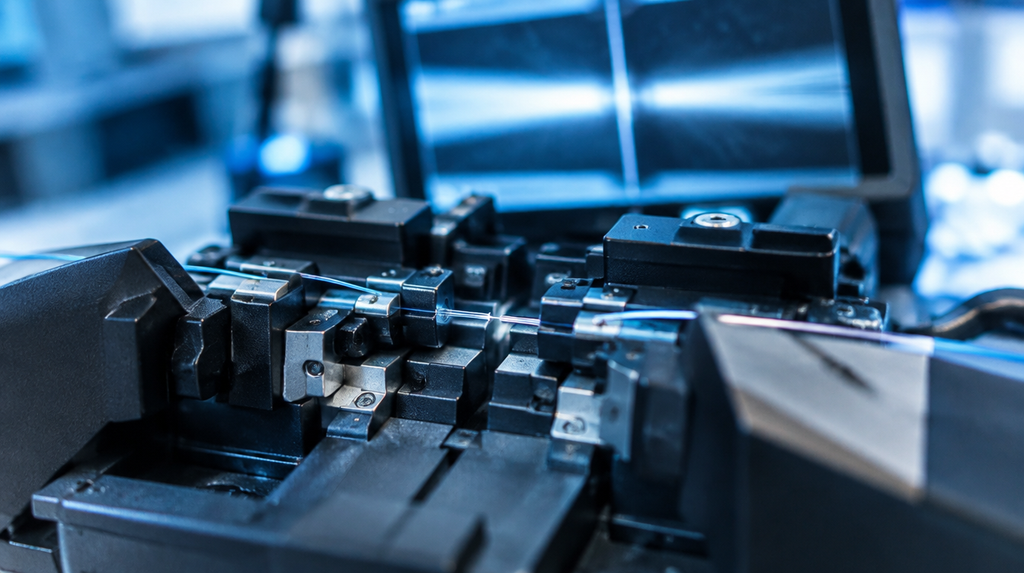
A repair begins with fault localization. Reflectometry narrows a break to a segment between two amplifier sites, after which a crew either excavates to a terrestrial splice enclosure or retrieves the cable from the seabed. The damaged section is cut out, armor and jacketing are stripped, the bare glass is cleaved and aligned under a microscope, the ends are fused, and the joint is sealed and tested.
This sequence is identical regardless of terrain — a splice under a highway and a splice on an ocean floor go through the same physical steps once the armor comes off. What varies by location is logistics and jurisdiction, not the exposure created by the splice itself.
Set that against the rest of a fiber’s operational life: sealed, buried or submerged, untouched for years at a stretch. During a repair, the individual glass fibers sit exposed on a bench, physically handled, for a day or more per joint. No other point in a cable’s lifecycle creates that level of sustained physical access.
Repairs run on permits, and permits define who has access
Cable operators don’t open a span wherever convenient. Repair work proceeds under whatever legal regime governs that stretch of seabed, right-of-way, or conduit, and it waits for approval before starting. Jonas Franken told MIT Technology Review that some countries take an average of six weeks to process a repair permit.
That approval process is worth more than a timeline. Whoever grants the permit can attach conditions, send an inspector, or place personnel alongside the crew for the duration of the work. That’s a meaningfully different access model from an intrusion:
- An intruder forcing a street cabinet gets minutes of access and leaves evidence of a break-in.
- An authorized repair crew gets days at the bench, under a permit that reads as routine oversight the entire time.
Regulators have flagged this as a live concern. The Wall Street Journal reported in May 2024 that U.S. officials warned telecom operators about Pacific undersea cables being vulnerable to tampering by repair vessels under Chinese control. In July 2026, Baker Botts partner Joshua Cole told AGBI that Iran’s newly formed Persian Gulf Strait Authority would plausibly extend its oversight from merchant shipping into the cable-repair vessels working the Strait of Hormuz.
Where the risk actually concentrates
Not every phase of a fiber link’s life carries the same exposure. The table below breaks down how physical accessibility changes across a cable’s operating lifecycle.
| Phase | Physical accessibility | Typical duration |
|---|---|---|
| In-service, sealed span | Fibers stay jacketed, buried, or submerged; no direct physical handling | Years between events |
| Fault localization | External measurement (reflectometry) only; cable stays closed | Hours |
| Active splice / repair | Bare glass fibers stripped of jacket and armor, handled directly on a bench | A day or more per joint |
| Post-repair, resealed | Returns to sealed, unhandled state | Years, until the next event |
The read-out is simple: exposure isn’t evenly distributed across a fiber’s lifecycle. It concentrates almost entirely in the active-splice phase — which is exactly the phase that authorized, permitted maintenance work walks straight into.
Why route diversity doesn’t close this gap
The standard resilience move for a fragile link is a second, geographically diverse circuit. That fixes availability: traffic keeps moving if one path fails. It does not fix interception exposure, which measures something different — how many points along a route could data be diverted to an unintended destination.
A second circuit doesn’t reduce that count. It increases it, adding a second set of splice enclosures, potentially a second maintenance contractor, and more people with legitimate, permitted access to an opened cable. Enterprises are also poorly positioned to audit this independently — a June 2026 report from Consortiv found that most organizations lack complete visibility into how their network services are physically delivered. A diversity guarantee is a commercial commitment about uptime. It says nothing about who will be standing over the fiber the next time a repair comes up.
Anyone evaluating what happens after a tap should also look at harvest-now-decrypt-later risk separately — a recorded copy of traffic doesn’t stop being a liability once the maintenance window closes.
What actually changes the exposure: securing the waveform, not the perimeter
Given how structurally difficult it is to prevent every possible tap during a legally sanctioned repair, the more productive approach targets a different question: what is a tap worth once it exists? Photonic-layer protection answers that directly by securing the optical waveform itself, so the exposure created by a maintenance window stops mattering.
CyberRidge’s Carmel platform is a working example of this approach. Deployed as a matched pair — one unit at each end of a protected span — it spreads the optical signal across a wide spectral band, embeds a constantly changing optical key into the transmission, and buries the result beneath amplified spontaneous emission noise. What typically gets left behind after a repair isn’t another splice; it’s a coupler clipped onto the fiber that skims off a fraction of the light without cutting the connection. Against Carmel’s approach, that coupler captures only noise with no recoverable structure.
CyberRidge deploys Carmel as an alien wavelength over third-party DWDM line systems, substituting a transmission line card rather than requiring a separate appliance or a rebuild of the transport layer — which means the protection can be layered onto a route already carrying live traffic.
Bottom line
A fiber optic cable is most exposed not during a covert intrusion but during a routine, authorized repair — a window that can run for days and is governed by whoever holds permitting authority over that stretch of seabed, right-of-way, or conduit. Route diversity improves availability but adds exposure points rather than removing them. The more durable fix targets what a tap is worth rather than trying to prevent every possible one, which is the approach photonic-layer platforms like CyberRidge’s Carmel are built around. Before the next scheduled maintenance window, it’s worth confirming which routes a circuit follows, whose jurisdiction each stretch crosses, and who actually holds permitting authority along the way.
FAQs
Q: Can a fiber optic cable be tapped during repair or maintenance work?
A: Yes. The splice required to repair a fiber span is the one point in its operating life where the bare glass fibers are stripped of their jacket and physically handled, sometimes for a day or more per joint, under a permit rather than under close scrutiny.
Q: Does adding a second, diverse circuit reduce this risk?
A: No. It improves availability if one path fails, but adds a second set of splice enclosures and a second permitting process rather than removing the first, which increases the number of potential exposure points.
Q: Who controls physical access to an opened cable during a repair?
A: Whichever authority issues the maintenance permit for that stretch of seabed, right-of-way, or conduit. That authority can attach conditions, inspect the work, and station personnel alongside the crew for the duration.
Q: What does CyberRidge’s Carmel platform actually protect against?
A: Rather than preventing a tap from being installed, Carmel makes whatever is captured during a maintenance window unusable. Operating at Layer 1 with a constantly shifting optical key buried in noise, it leaves a coupler recording unrecoverable optical noise instead of a storable copy of traffic.
Q: Does adopting photonic-layer protection mean replacing existing network equipment?
A: No. CyberRidge deploys Carmel as an alien wavelength over third-party DWDM systems, substituting a transmission line card rather than adding a separate appliance, so existing ROADMs, amplifiers, and transport equipment stay in place.